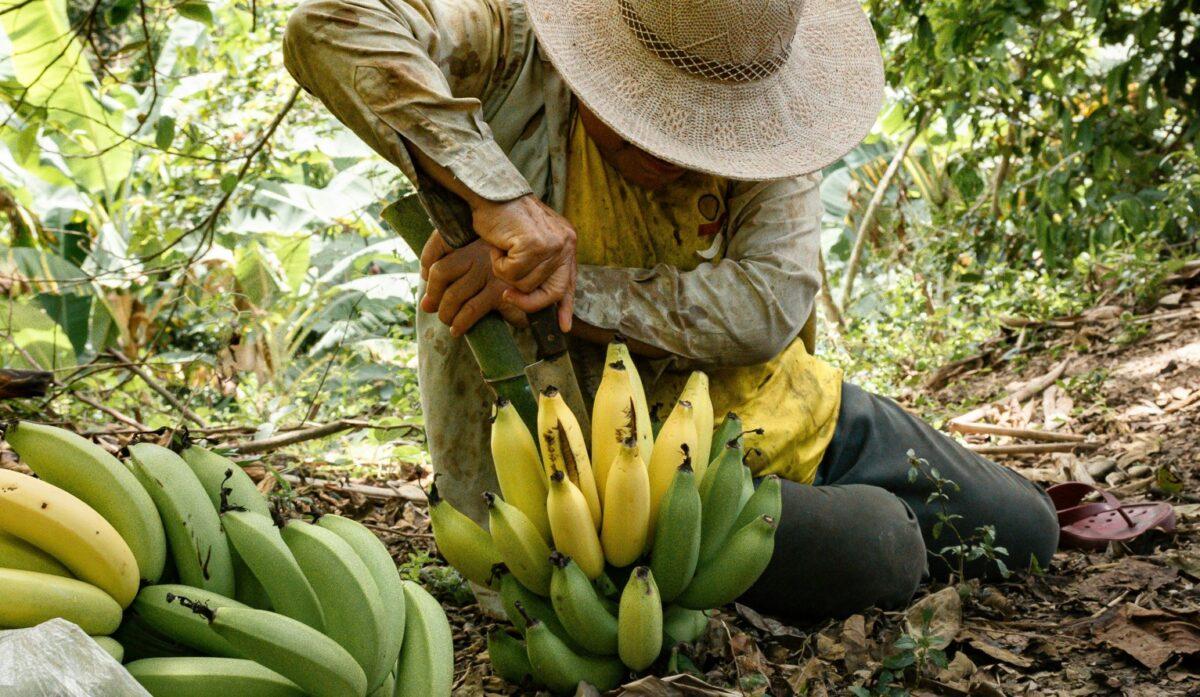
Bananas are among the world’s most popular fruits—but they don’t grow in Europe. The largest growing regions are in tropical areas, including Latin America (Ecuador, Costa Rica, and Colombia), parts of Africa, and Southeast Asia. From there, they travel thousands of kilometers before ending up in our supermarkets. Despite these long transport distances, bananas surprisingly don’t have the worst carbon footprint—mainly because they are usually transported by ship. IMAGE: Pixabay
Tropical fruits at the hotel—a no-go?
Hotels in the Green Pearls® network prioritize regional and seasonal products. For many European hotels, this means avoiding tropical fruits whenever possible.
The Paradiso Pure.Living Vegan Hotel in South Tyrol also has a clear philosophy. Hotel owner Maximilian Spögler and head chef Aggeliki Charami explain:
Tropical fruits are rarely available here. All of our products are organic. We only use bananas in small quantities, such as for our homemade banana bread. Currently, we source our bananas from Europe, specifically the Canary Islands. However, we hope to soon source them from Sicily.
Bananas from Italy?
Due to climate change, what once seemed unthinkable is increasingly becoming a reality: For the first time, Chiquita is growing organic bananas in Europe—specifically in Sicily’s Ragusa region. Around 20,000 plants have been planted, and the first harvests are planned for 2026 – initially in small quantities.
It is unclear when these bananas will hit the market. However, the plantation is already being viewed as a gateway to the European market, rather than just a pilot project.
How harmful are bananas to the climate?
According to a study by the Heidelberg Institute for Energy and Environmental Research (ifeu, 2020), bananas generate approximately 0.6 kg of CO₂ per kilogram.
This means they score lower than regional apples (0.2–0.3), but higher than:
- Imported apples (0.8)
- Greenhouse tomatoes (up to 2.9)
- Frozen vegetables, such as peas (1.2) and broccoli (0.7))
In other words: Bananas aren’t perfect, but they’re often more climate-friendly than their reputation suggests.
You can download the PDF about the ecological footprint of food here.
What now?
The best choice is organic bananas from Europe, if possible.
Otherwise, the following applies:
- Look for organic products
- Buy fair trade bananas
- Ask about the origin and production conditions.
This is due to the fact that, in addition to the environmental impact, social factors also play a significant role. An interview with a union representative from a Costa Rican banana plantation reveals the harsh conditions that workers often endure. The use of pesticides is particularly harmful. Thousands of people in Central America still suffer from the consequences of the pesticide Nemagon today, including infertility. Nemagon was used in the 1980s. According to the union representative, workers are still exposed to pesticides today. Organic farming shows that it is possible to do without pesticides, and it should be worth a few cents more to you!
P.S. Check out our insights on orange juice to learn whether you can drink it for breakfast without worrying.

 Loading...