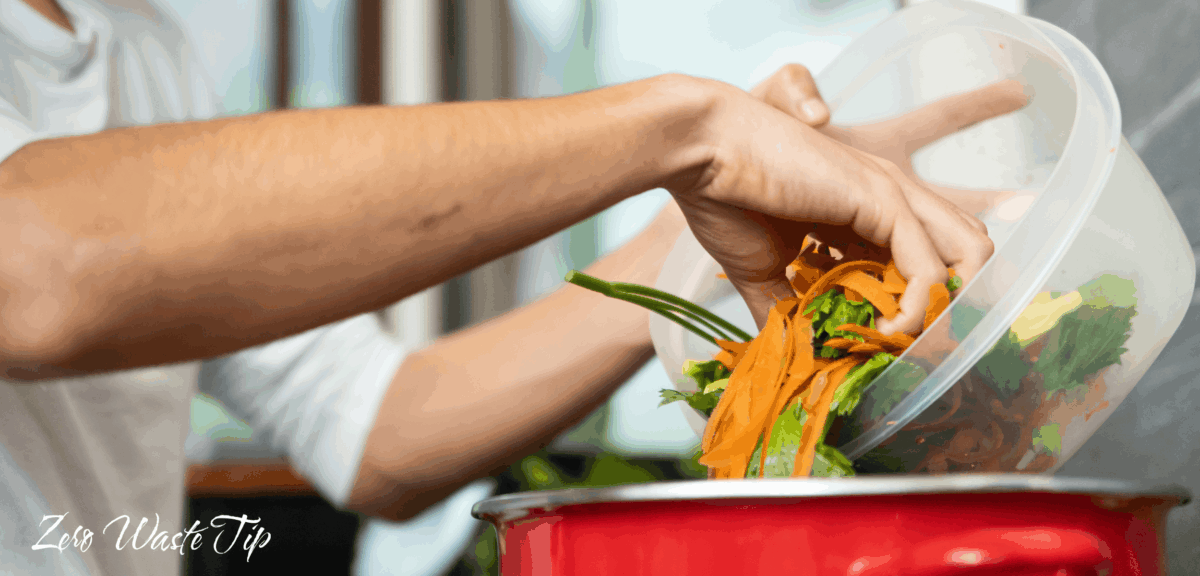
If you cook with fresh ingredients often, then you’re probably familiar with this: After preparing your meal, you’re left with lots of peels and vegetable scraps. Most of the time, these scraps end up in the compost bin or even the trash can. However, they contain as much flavor as processed vegetables. It’s a shame to throw them away, isn’t it? | Image via Canva
What to do with vegetable scraps?
That’s exactly what I thought! So, when I read a tip about collecting scraps in the freezer for later use, I was excited. Once you have collected enough scraps, you can use them to make vegetable stock – either for cooking with it right away or to preserve it for later.
Personally, I’m not a fan of things that create extra work. And this zero-waste tip requires virtually no work.
You don’t need any special kitchen appliances or cooking skills, either. The only prerequisite is the ability to freeze things. You also don’t need to do much to prepare the vegetable scraps. Just wash them and blanch them if necessary (I like to blanch broccoli, for example.) Then, put them in a freezer bag and freeze them. Make sure you don’t freeze any spoiled or moldy peels. But that goes without saying, right?
Here’s how to make vegetable stock from vegetable scraps
You will need:
- Approximately 700–800 grams of vegetable scraps (for me, that’s about a full 3-liter freezer bag)
- Approximately 2–3 liters of water
- A large pot (it’s better to have it be too big than too small, so you can stir comfortably)
- A sieve for straining
- Clean preserving jars of the appropriate size if you want to preserve the broth for later
How it’s done:
- Put your vegetable scraps in the pot. Let them thaw a little; frozen vegetables also work.
- Pour enough water over everything. The vegetables should be well covered (by at least the width of one finger).
- Bring everything to a boil, then simmer on low heat for about 30 minutes.
- Next, pour the stock through a strainer into a measuring cup or second pot. Now you can use it.
- To preserve the broth, bring it to a boil again. Then, pour it into clean, preferably sterile, jars while it is still hot and seal them immediately.
- You can also add spices or salt to the stock. I prefer to use the stock as a neutral base and season the food to taste.
A few questions to finish:
Can onion skins go in the leftover bag?
I often read that brown onion skins make the broth bitter. However, I can’t confirm this. I’ve always used a significant amount of onion scraps in my broths, and none of them have turned bitter. Of course, you shouldn’t use only onion skins, but a few won’t hurt, in my experience.
Which vegetables are suitable for vegetable stock?
In principle, you can use anything that would normally go into a vegetable stock. I usually have the following in my scraps bag:
- Carrot peels
- Potato peels (remove eyes and sprouts beforehand)
- Leftover leeks and spring onions (including the lower part)
- Outer leaves of cabbage (as long as they’re reasonably okay)
- Stems from broccoli, cauliflower, bok choy, etc.
- Mushroom scraps (as long as they can be cleaned well)
- Leftover celery stalks or celeriac
- Zucchini scraps (I rarely have these)

 Loading...