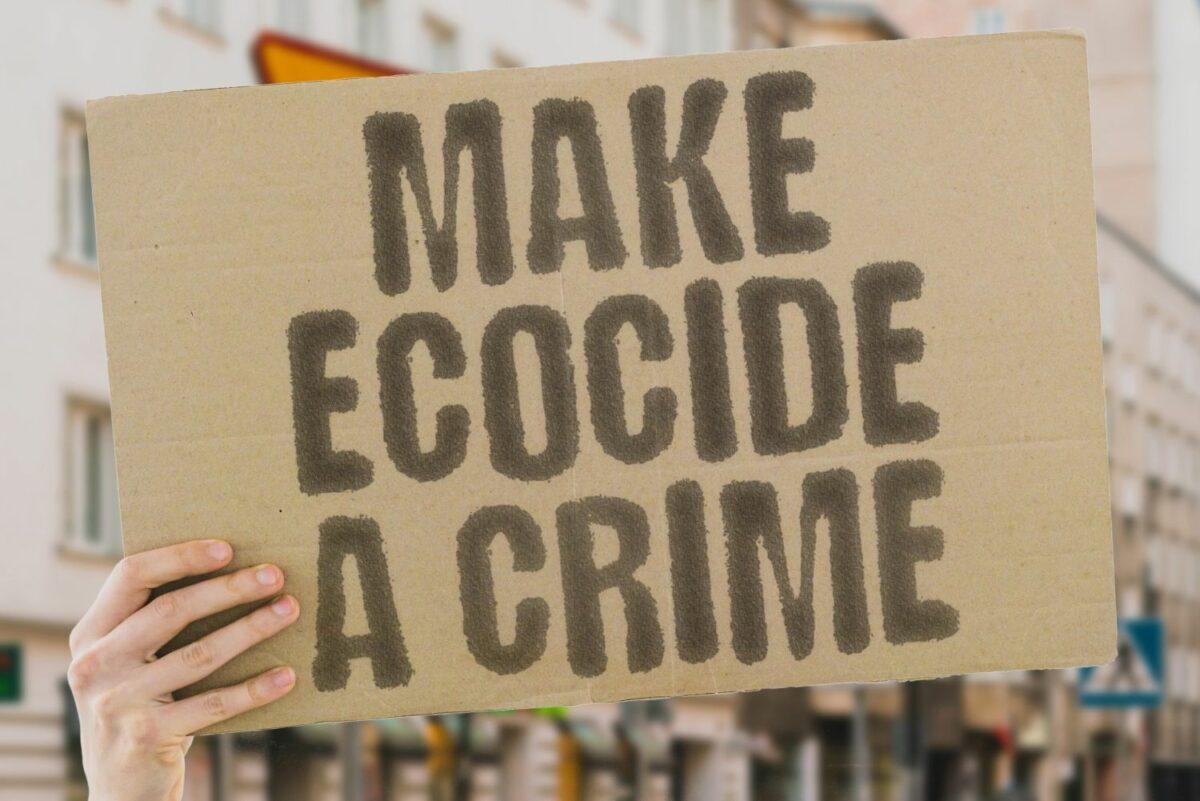
Today’s Insight will focus on a slightly different topic. The term ‘ecocide’ and its significance in the context of environmental protection. First, I will define the term and explain its legal status (sorry!), and then I will discuss why it is important. IMAGE: ©AndriiKoval | Stock.Adobe.com
The legal status of “ecocide”
The term “ecocide” has not yet been formally defined in law. Broadly speaking, however, especially in international law, it refers to any intentional act that is highly likely to cause widespread or long-term environmental damage.
This can range from the chemical poisoning of a river or forest to radioactive contamination from nuclear weapons. It also includes knowingly causing serious emissions that damage the climate.
Given this, it is no surprise that ecocide has only been discussed in international law. And none of the initiatives among to incorporate it into the Rome Statute (the basis for the law of the International Criminal Court) have been successful. After all, many parties have a financial or other interest in preventing such a potential offence.
Not to mention that the worst polluters, such as the US and China, do not recognise the International Court of Justice anyway, nor have they signed such treaties.
Regional level
The situation is different at national and regional levels. There, countries such as France, along with twelve others, have already incorporated ecocide and similar environmental crimes into their criminal legislation. Following the recognition of the term ‘ecocide’ under EU law in 2023, a directive on the criminal protection of the environment against ecocide-like damage was officially adopted within the EU in 2024. Interestingly, Germany was the only country to vote against it. This gives EU members until around 2026 to incorporate this offence into national law.
Why is this important anyway?
Given all these legal nuances, it is only natural to ask why such an inclusion in international or transnational law should play a role at all, particularly in Germany. Following the 2021 climate ruling by the German Constitutional Court, environmental protection was enshrined in constitutional law, yet this had little impact on realpolitik.
At the international level, this problem is reflected in the enforcement of judgments by international courts such as the ICJ and the European Court of Human Rights. (However, it should be noted that the EU has significantly more executive powers at its disposal, such as the ability to impose fines, that are more difficult for member states to evade.)
At the international level, such inclusion primarily makes sense from a normative perspective. It allows for a uniform definition of the term and its legal status. This makes it easier for countries, especially those across borders, to hold environmental polluters, such as large corporations (e.g., oil spills from tankers), accountable. Lawsuits can also be filed internationally, enabling an external court to assess and rule on conflicts between states or between states and corporations.
At the regional level, especially the EU level, such inclusion promotes and standardizes the coordination capabilities of various law enforcement agencies. At the national level, it increases pressure on governments to adapt their laws and take environmental protection more seriously.
This classification is also important for the scope of action of all stakeholders. After all, people think twice about taking risks when there are serious consequences.
In other words: it plays a role in environmental protection at every level!
Conclusion
After this probably overly technical explanation (I’m a political science student, sorry again). I hope I was able to convey the importance of this issue to you and give you a better understanding of the topic. I would love to know if you had ever heard this term before and what your opinion is on the subject. Please write your comments below!

 Loading...